

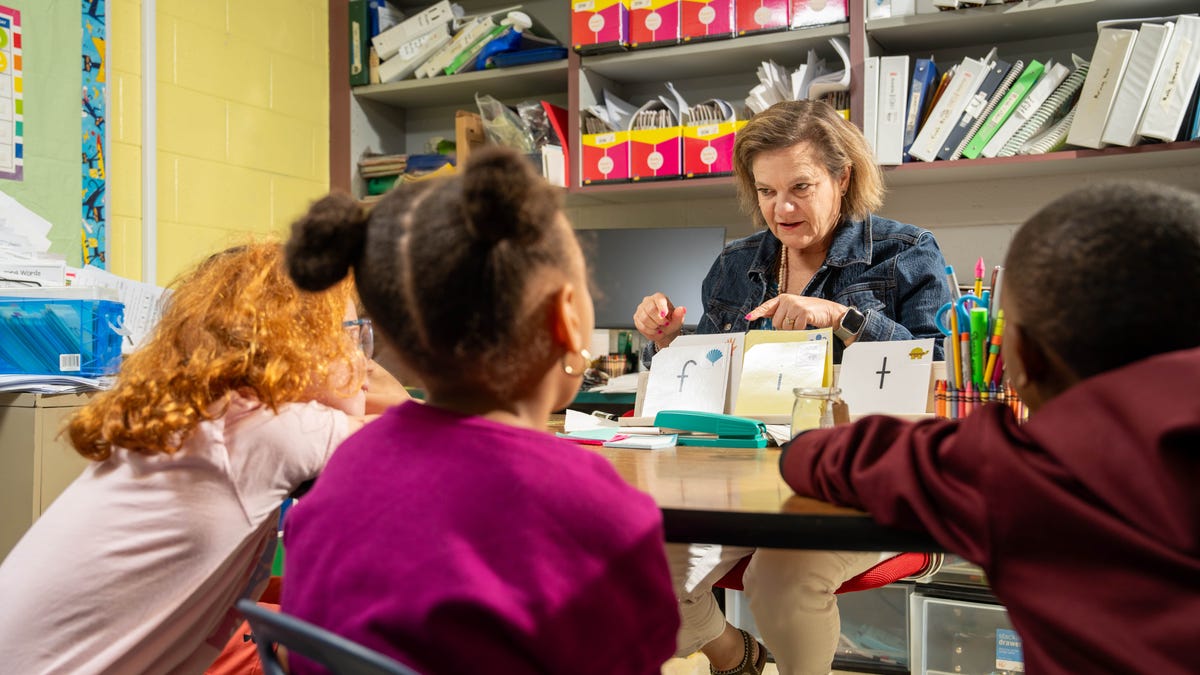
“I once had a student who hated math, but he loved football, so we did daily problems around Auburn University football,” says Suzanne H. Collins, who teaches second grade at Rocky Ridge Elementary, a public school in Hoover, Alabama. “He soon discovered he was good at math.”
We all have different ways to learn, process and retain information and these self-reported preferences are called learning styles. When Collins first began her teaching career in 1987, all students learned just one way: by reading and writing, also known as linguistic learning.
Though some educators propose that there are eight or more styles, the most recognized fall into these four categories: visual, auditory, kinesthetic and reading/writing. Reading/writing, the traditional mode, relies on textbooks and note-taking. Visual learners respond best when information is presented with pictures, diagrams, symbols and colors, and tools like flashcards. Auditory learners tend to process information best when it’s spoken and perform well on tasks that emphasize listening and discussion.
Collins has a very diverse population of learners in her classroom, ranging from kindergarten to fourth grade reading levels. She’s seen the results of a more tailored approach to teaching, particularly kinesthetic and auditory methods.
“Students use colored sand in trays so that when they spell a word, the color of the sand changes,” says Collins of her kinesthetic students. “We do a lot of work with rhyming. For many children, this is a light bulb moment. Once they realize that words like man, pan, can and ran all have the same sounds, it opens new doors.”
Collins says what works for one child won’t necessarily work for all, but that’s where having many different methods is vital. “If a child’s learning style is identified and used, they grasp concepts more easily and in turn, their academic skills improve at a more rapid pace.”
A More Engaged, Effective Learning Environment
While some researchers claim the concept of learning styles is a myth, some mainstream schools are incorporating a student’s learning preferences into their curriculum in the hopes that kids experience school and learning positively. Educators and parents are increasingly enthusiastic that matching learning styles to students will reap academic rewards.
Emily Levy is the founder and director of EBL Coaching. In her experience, there aren’t significant changes in learning styles as kids get older, nor notable gender-based differences. But neurodivergent children may benefit from specialized learning.
“Students with learning disabilities, ADHD and autism seem to do best with a multisensory approach that combines the visual, auditory, and tactile/kinesthetic modalities simultaneously when teaching new concepts,” maintains Levy.
Dr. Eric Alcera is vice president and chief medical officer at New Jersey’s Hackensack Meridian Health Carrier Clinic. “As a child and adolescent psychiatrist, I can attest to the fact that children and adolescents have different learning styles that sometimes don’t align with their school environment or teacher, which can lead to frustration. Frustration can ultimately affect self-esteem, confidence and possibly anxiety-related learning issues, emphasizing the need to adapt learning styles and strategies to each child’s strengths.”
Parents need to be educated to recognize symptoms so they can advocate for appropriate school adaptations, so their child is motivated and thrives, Alcera says. Rachel Cederbaum is a classroom teacher turned academic coach and the parent of two school-aged children. So how can parents determine what method resonates with their kids? She suggests parents ask their kids directly if they learn best through note-taking, reviewing visuals, listening to teachers’ lectures or doing things.
“Students’ answers to these questions allow parents to discover how their kids understand content to support their studies,” says Cederbaum. “Our job as parents is to discover how their brain works. This awareness builds academic confidence, skill and independent learning.”
In Cederbaum’s experience, most students are visual learners, or “at least require differentiated instruction, visuals and a variety of engaging activities to effectively learn.” Like Collins, she’s observed tremendous value and necessity in catering to students’ different learning styles.
Everyday Interactions Enhance Learning
“Folks have been researching learning styles for a long time,” says James Ernest, a professor of early childhood education and department vice chair of curriculum and instruction at the University of Alabama at Birmingham. “Some trace the idea of a ‘style’ back to Carl Jung in the 1960’s; other academics think of Aristotle’s writings from around 334 BC, noting ‘every child possessed specific talents and skills.’”
Ernest admits that data indicates that the results of creating educational programs that focus on learning styles are marginal at best. “We all know no two kids are quite the same. As a parent my advice is to focus on the things that your child loves to do. With my own kids, John might have been more receptive to pictures and object manipulation, and how I used rhythms and tone was important. My other son, Sam, might respond differently with gestures or express himself with paintings.”
But as a general rule, every child is a visual learner and that’s the way to capture and hold their attention, Ernest says.
“Go outside and explore the world. Encourage kids to get wet when it’s raining. Walk and talk about what you are seeing. Focus on connections, talk about shapes and their relationship to each other in daily routines, like when you’re cooking. For younger children, the relationships between numbers, counting our cookies or baby carrots.”
Ernest says parents can “foster estimation and the processes of problem-solving at every age by using open-ended questions like, ‘How do you know?’ or ‘How can we figure this out?’ So much of achieving in life is not just about having academic skills, but applying knowledge and skills to real life problems,” he says.
Collins maintains that it’s a teacher’s duty to determine how each child learns best and make that happen. And what about her student who learned math through Auburn football?
“He went into education, became a teacher, and is now the athletic director for a large school system here in Alabama.”
That’s an academic touchdown.
link