

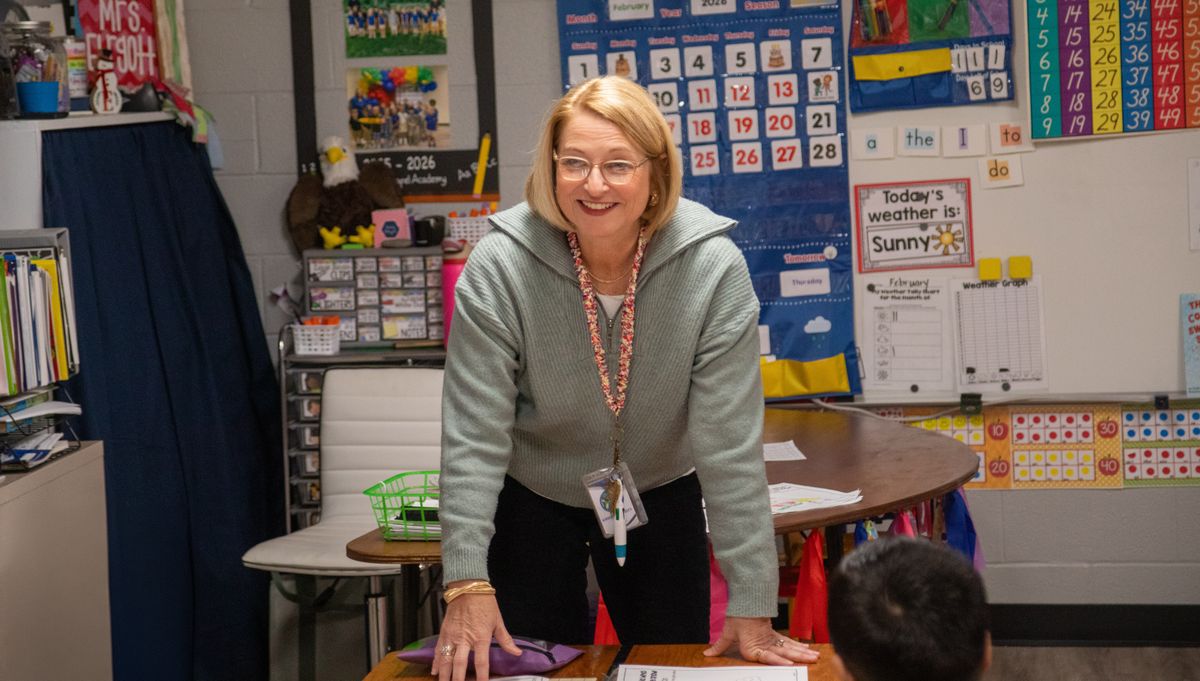
Ehrgott said that she uses simple assessments as one strategy to measure and improve student achievement. For example, she uses weekly reading checks.
“These include letter-sound fluency, picture sorts to find beginning sounds, and one-on-one reading of short decodable books. For example, when I saw that several students were having trouble blending simple CVC words, I started a daily small group ‘tap and blend’ routine using magnetic letters and sound boxes,” she said. “After a few weeks, their reading assessments showed real improvement in decoding, which proved that the small-group practice was helping.”
Ehrgott uses her assessment data to customize lessons to fit individual students’ learning styles.
“Students experience success because the instruction is constantly changing to match their needs and help them grow at their own pace,” She said.
Ehrgott also shared one of her most moving success stories.
“There was a student at my school whom I’d watched during after-school duty for a full year. I dreaded the thought of ever having him in my own classroom for 180 days,” she said. “He talked constantly. He never stopped talking — or moving. I’ll call him Jack. He’d only been at our school for a year or two, but everyone knew who Jack was.”
Jack was put into Ehrgott’s class. His mom shared with Ehrgott that he had been non-verbal and non-functioning for the first five years of his life.
“They had taken him to a big city for intensive therapy, weeks at a time. Suddenly, I saw him differently. I appreciated how far he had come,” Ehrgott said. “And what surprised me most was that he always talked to me—really talked. He shared his thoughts, his worries, his dreams. It didn’t matter if it was the middle of a lesson, lunch, or recess. We connected, especially over one shared trait: neither of us liked to be touched.
“Later that spring, I told my students that I would be teaching first grade the next year. Jack pulled me aside and said, very matter-of-factly, that I needed to prepare myself to be hugged because ‘little kids like to be hugged.’ He wanted me to be successful, just as I wanted him to be successful,” she said. “And he decided he would help me. So, he began giving me one hug every day. It changed me. It changed him.
“The child I once dreaded became the child I missed the most. They say students may not remember what you teach them, but they will never forget how you made them feel. I will never forget how Jack made me feel,” Ehrgott said. “I teach because their hearts, worries, and wonders refuel my purpose.”
One elementary and one secondary Educator of the Year will be announced at the Chamber Luncheon on Feb. 18. First-place winners in each category will each receive $1,000, courtesy of Ameristar Casino. Two runner-ups will also be named. They will receive $500 each, sponsored by Mutual Federal Credit Union. Each nominee will also receive eight gift cards for free sandwiches courtesy of Chick-Fil-A.
link