


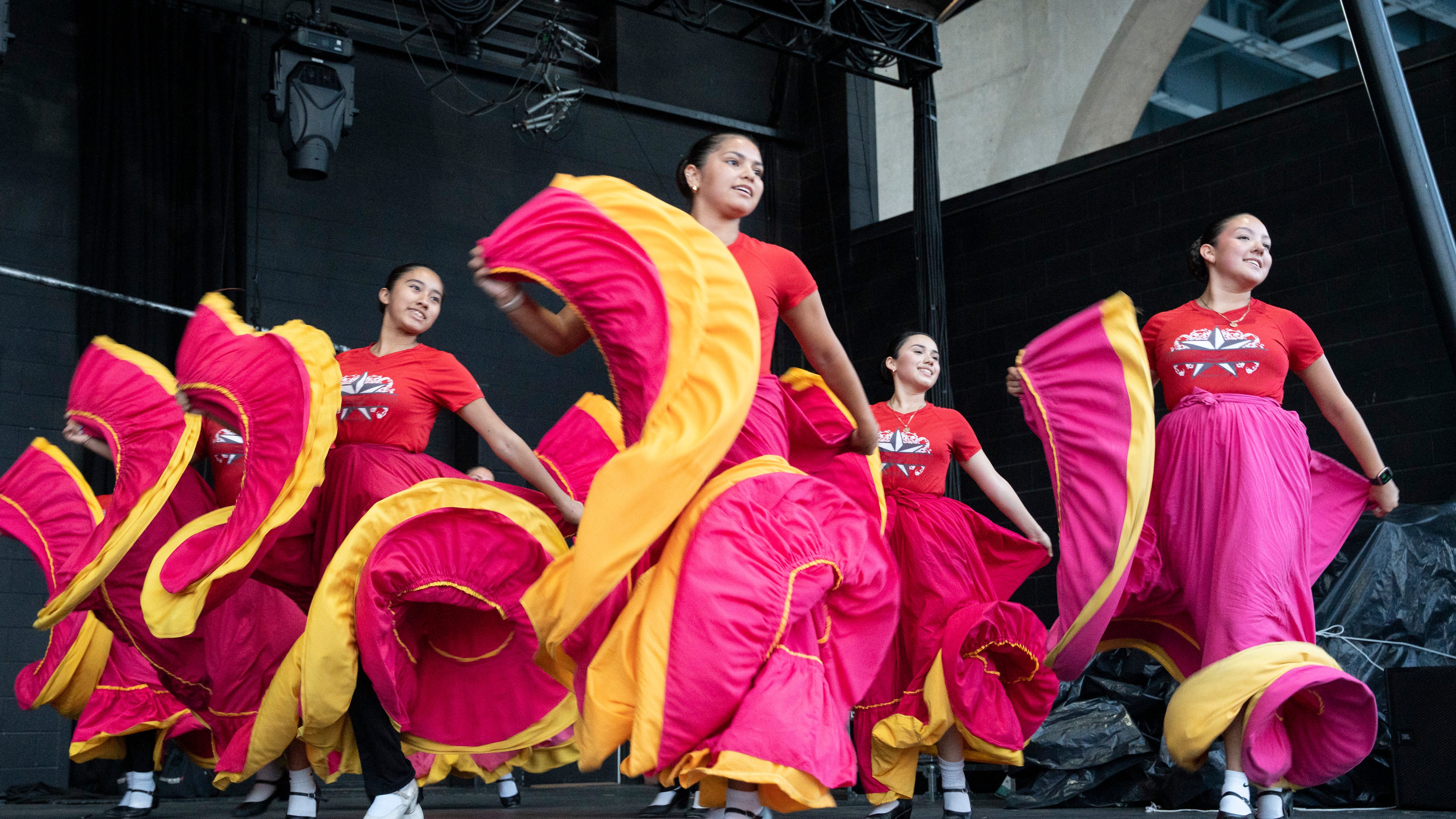

Dance Academy of Mexico dancers rehearse before Mexican Fiesta
On Friday, Dance Academy of Mexico dancers will perform folkloric dances at Mexican Fiesta.
While practicing a folkloric dance from Veracruz, Mexico, on Tuesday, Aug. 19, at Henry Maier Festival Park, a group of dance students balanced candles on their heads while making quick steps and waving their colorful skirts to the music.
One student dropped her candle. She remained unfazed and kept moving along with her teammates — modeling the poise she’ll need during her performance at the 52nd annual Mexican Fiesta on Friday, Aug. 22, at noon.
The dance students are members of the Dance Academy of Mexico, a Milwaukee-based dance organization founded in 2010 to teach and preserve traditional Mexican folkloric dance. They have been preparing for this performance since January, according to Marina Croft, director of the Dance Academy of Mexico.
Each year, the group performs at Mexican Fiesta to showcase folkloric dance and share Mexico’s rich history and culture with the city of Milwaukee. This year will be the academy’s 14th performance at the festival, Croft said.
“We’re really proud, happy and content that people actually want to learn about it. That they want to see it; that they want to take videos and ask questions,” Croft said.
In addition to the group’s 45-minute dance performance scheduled for Friday at noon, the Dance Academy of Mexico’s 56-person dance troop will perform in the three-day fiesta’s opening ceremony along with several local, national and international dance groups.
The opening ceremony, at 5 p.m. on Friday, will honor the Mexican Revolution, the theme of this year’s event.
A tour of Mexico’s folkloric dance styles
Dance Academy of Mexico focuses on traditional and indigenous folkloric dances from Mexico’s 31 states and federal district, allowing audiences to take a tour around the country through song and dance, said Croft.
This year, the academy will perform 15 folkloric dances, each representing a different region of Mexico, according to Croft.
“I like to show off the diversity of Mexico itself, because I think a lot of people don’t realize that each state of Mexico has its own dances; its own flavor,” said Edgar Padilla, a dancer who has performed with the academy since he was 12 years old.
For example, Veracruz’s folkloric dances have Spanish and Caribbean influences, as the dance style comes from a region near Mexico’s trading ports, Croft said.
Dance styles from Northern Mexico were originally influenced by Polish and German immigrants. Some of the region’s dances are called “polkas,” and the movements are similar to traditional Polish and German dances, according to Croft.
The dance academy’s Azteca folkloric dance routines honor ancient Aztec religions, and that’s reflected not only through the dance movements, but through the symbols on their costumes, she said.
Students discover identity through dance
Many of Croft’s students have never had the chance to visit Mexico or immigrated to the United States at a very young age, she said.
“For a lot of them, the only connection that they have to their parents, and their own heritage, is through coming and doing these activities,” said Croft.
The pressure to adapt to American culture is very high, but they use dance to connect with their family history and culture, she said.
“It’s about knowing who you are and where you come from, so that you have the chance to know that you’re worthy; that you’re able to present something that’s different,” Croft said.
Croft goes the extra mile to make sure students can afford to participate in the dance group and its performances, like Mexican Fiesta, by purchasing the students’ costumes and loaning them to dancers.
She said this allows more families to register their children without the expenses, while keeping the tradition of learning folkloric dance and its stories alive for future generations, Croft said.
The costumes can run anywhere from $800 to $1200, Croft said. This does not include the cost of feathered headpieces, where each feather can cost up to $20.
The costumes are a worthy investment. The practice of learning different folkloric dances teaches students the importance of discipline, perseverance and teamwork.
These values align the group with Mexican Fiesta’s mission of supporting lifelong learning, Croft said.
Mexican Fiesta began in 1973 as a celebration of Mexican Independence Day. The proceeds from the festival support the Wisconsin Hispanic Scholarship Foundation, which awards scholarships to young Hispanic men and women, according to the website.
“They’re very accomplished academically, but I also think having this activity alongside their academic coursework, it really helped them out,” Croft said of her college-aged students. “It’s an all-encompassing activity that sometimes get overlooked.”
Passing the baton to the next generation of dancers
Dulce Castro is a first-generation Mexican American student who has been practicing folkloric dance since she was 3 years old. She has danced with the academy since she was 5 years old.
“My mom used to dance, and so did her siblings, so she gave the dedication for dance to me,” Castro said. “My mom passed down that love to me.”
Over the past three years, all while balancing school and multiple jobs, Castro, 17, has been an instructor for the dance academy’s youngest dancers, she said.
“I’m just seeing myself when I was their age. My heart is full,” she said. “They’re going to be our new generation.”
Castro has never missed a Mexican Fiesta performance. She said sharing folkloric dances and the stories behind them with the Milwaukee community fills her with pride for her culture.
“This is our hometown show, and we want to make it a big show,” said Castro. “We want to show our love and our dedication to our culture at Mexican Fiesta.”
Alyssa N. Salcedo covers Layton Boulevard West for the Journal Sentinel’s Neighborhood Dispatch. Reach her at [email protected]. As part of the newsroom, all Alyssa’s work and coverage decisions are overseen solely by Journal Sentinel editors.
Support for this effort comes from the Zilber Family Foundation, Journal Foundation, Bader Philanthropies, Northwestern Mutual Foundation, Greater Milwaukee Foundation and individual contributions to the Journal Sentinel Community-Funded Journalism Project. The project is administered by Local Media Foundation, tax ID #36‐4427750, a Section 501(c)(3) charitable trust affiliated with Local Media Association.
Learn more about our community-funded journalism and how to make a tax-deductible gift at jsonline.com/support. Checks can be addressed to Local Media Foundation with “JS Community Journalism” in the memo, then mailed to: Local Media Foundation, P.O. Box 85015, Chicago, IL 60689.
link