


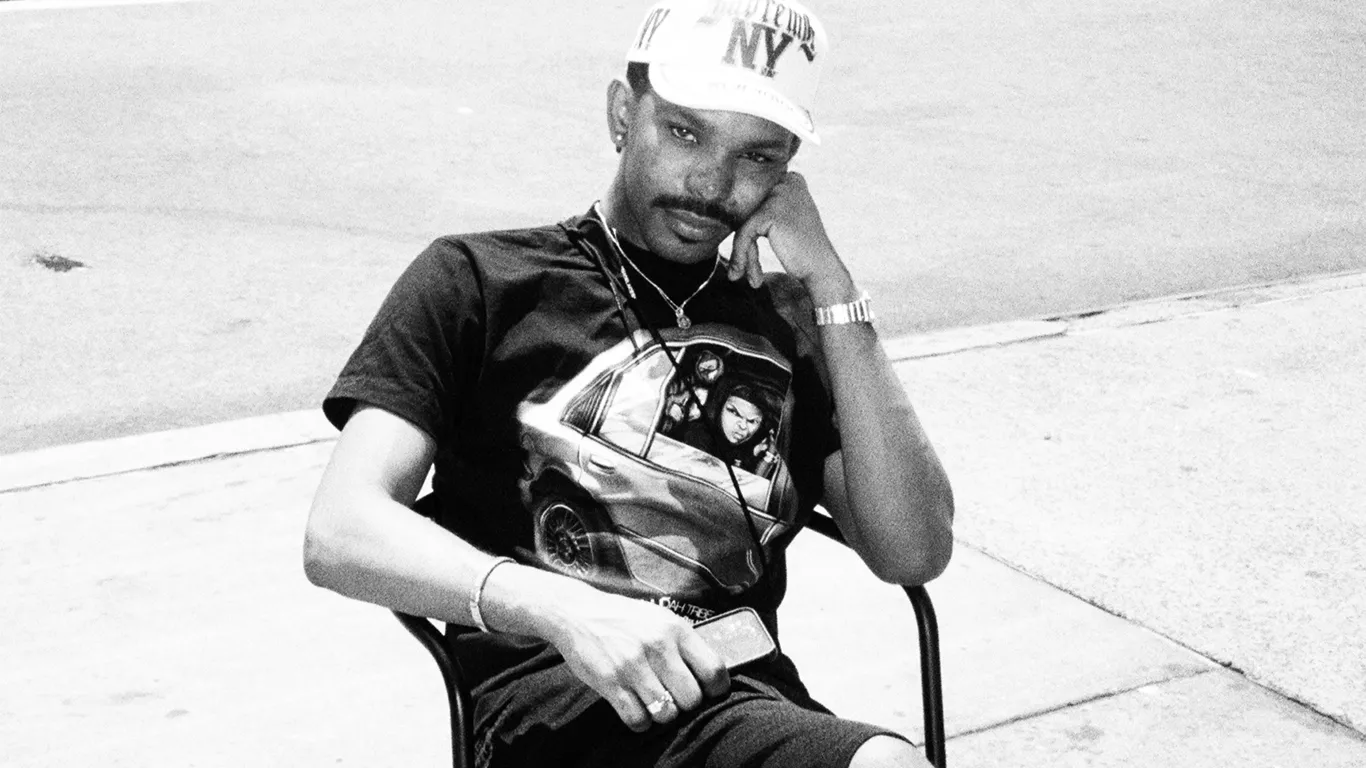
Nigerian-born creative director Dede Jemide is redefining the visual language of British culture, fusing art, sport and street sensibility into a vision entirely his own
From Warri to Wembley, Creative Director Dede Jemide is redefining where art, sport and fashion collide. Partnering with artist Olaolu Slawn, he’s helping shape a new visual era for British culture, one where Nigerian creativity takes centre stage.
On a bright May afternoon at Wembley Stadium, a wide banner unfurled across the pitch as the FA Cup Final crowd rose in unison. The design was loud and unapologetic, graphic, mischievous, impossible to ignore. It wasn’t decoration but declaration, a burst of colour and character that turned a football match into a living artwork.


Courtesy of Dede Jemide
Freedom to create, to move, to build
Dede Jemide
Few in the stands realised that behind the spectacle stood Jemide, the quiet creative force translating the visual chaos of artist Olaolu Slawn into something monumental. At twenty-seven, Jemide occupies a rare space in Britain’s creative landscape: both insider and interpreter, the man shaping the look and feel of one of the country’s most unpredictable artistic voices.
As Creative Director for Slawn Art, he moves fluidly between fashion, fine art and branding, stitching together worlds that rarely meet. His work is sharp and visually charged, redefining how art lives not just in public spaces but in space itself.
Born Oritsetserundede Jemide in Warri, Delta State, Nigeria, he grew up in an Itsekiri household where creativity was simply part of daily life. “Itsekiri people are expressive by nature,” he says. “We love to make an impression, whether through conversation, dressing or design.”


That expressive energy shaped him early. His mother, a fashion designer, encouraged curiosity, sending him to summer camps that offered everything from jewellery-making and digital design to sewing and crafts. “She wanted me to explore,” he recalls. “Those summers taught me that art could exist anywhere — in clothes, on a wall or on a screen.” The lesson stuck. “I never see a difference between design, art and fashion,” he adds. “It’s all communication. It’s all storytelling.”
Like many millennials who came of age in the early 2010s, Jemide’s creative education happened as much online as off. The golden age of Tumblr was his visual playground, a mix of streetwear, art direction and music subcultures where references moved faster than trends.
“Back then, you didn’t need to live in Paris or New York to feel connected to the global conversation,” he says. “You just needed Wi-Fi and taste.” Influenced by Virgil Abloh, DONDA and A$AP Mob, he came to see design as a driver of culture. “That era gave us the blueprint for what culture looks like today,” he explains. “It was design as identity.”
In 2020, Jemide launched Jaecreate, a creative agency that began as a solo project but quickly became a collaborative platform. The studio offered graphic design, production and creative direction for brands in Lagos and London, such as FoodCourt, Sleeks Matcha, Cult Army and SweatBox.


Courtesy of Dede Jemide
The pandemic, he says, unexpectedly accelerated things. “Suddenly everyone was online. You could work with global clients from your living room,” he laughs. Jaecreate’s work balanced clean, conceptual design with the pulse of Lagos street culture. “We kept it modern but rooted,” he explains. “Something global audiences could understand without losing where it came from.” Those years also taught him how to manage teams, clients and creative systems, experience that would later prove invaluable.
He first met Olaolu Slawn in 2016 at a pop-up he organised for independent streetwear brands in Lagos. “Slawn’s always had this unpredictable energy,” Jemide laughs. “He’ll throw the wildest ideas at you, and somehow they make sense.” Their friendship developed long before they began working together, but by the summer of 2023, when Jemide spent time in London, collaboration felt inevitable. “We’d always talked about doing it properly,” he says. “The timing just felt right.”
Courtesy of Dede Jemide
As Creative Director, Jemide oversees all of Slawn’s design output, from brand collaborations and merchandise to exhibitions and campaigns. Whether it’s a Slawn × Louis Vuitton T-shirt or the now-iconic FA Cup Final pitch banner, his fingerprints are everywhere. “My job is to make the chaos coherent, to turn raw energy into something that lasts,” he explains. “I make sure the vision stays raw but consistent.”
The Wembley project, he says, wasn’t just another commission; it was a cultural statement. “Football is culture. It shapes music, language, fashion, so why shouldn’t it also shape art?” The banner’s design was cheeky, defiant and unmistakably contemporary, a visual metaphor for how British sport and African creativity are beginning to converse. “That moment showed what’s possible when art enters spaces people don’t expect it to,” he says. “You can challenge perception without saying a word.” It was also, in many ways, a rehearsal for the next chapter of his career: building bridges between communities, industries and aesthetics.
Courtesy of Dede Jemide
Inside Slawn’s west London studio, the atmosphere feels more like a creative laboratory than a conventional workspace. Music hums from a speaker, sketches and test prints cover the walls, and assistants move between computers and canvases, balancing deadlines with bursts of inspiration. “It’s controlled chaos,” Jemide smiles. “Slawn might call me at midnight with an idea, a phrase, a colour or a sketch, and by the next morning we’re building it into a design system.”
See also


Dede talks like someone who’s always one idea ahead of himself, his thoughts moving faster than his words can catch up. His background in both agency management and hands-on design lets him navigate that energy. “My job is to make sure ideas survive the process,” he adds. “That’s where real creative direction lives, between instinct and execution.”
One of his proudest full-circle moments was designing for the Off-White × Motherlan collaboration, a surreal milestone for someone who once studied Virgil Abloh’s every move. “Virgil was the reason a lot of us even picked up design in the first place,” he says softly. “To work on a project linked to him felt like closing a loop.”


Courtesy of Dede Jemide
Through his ongoing freelance work with Motherlan, he’s helped shape one of Nigeria’s most influential streetwear collectives, creating graphics, billboards and campaign material for partnerships with Dr. Martens and others. The result is a visual identity that’s bold but disciplined, quietly influencing the look of a new African creative era.
Jemide resists easy categorisation. “I describe myself as a multidisciplinary artist,” he says. “I’m into film, photography, even fashion design. It all connects.” His own label, Shade Club, explores mood and identity through minimalist silhouettes, while his growing interest in visual storytelling hints at ambitions far beyond the art studio. “I’d love to design a film poster for Christopher Nolan or even a product with Apple,” he says, half-joking. “I like challenges that stretch what design can do.”
For Jemide, success isn’t measured in fame or followers but in freedom. “Freedom to create, to move, to build,” he says. “That’s the real goal.”
What drives him most, though, is what comes next, not only for himself but for the wider creative community he represents. “I want to be proof that Nigerian designers can operate on a global scale without losing their authenticity,” he says.
Courtesy of Dede Jemide
The Nigerian scene, he believes, is entering a golden phase. Platforms such as Streetsouk and Homecoming are connecting local and diaspora artists, while new designers and painters are rewriting the narrative of African creativity. “The scene is already there,” he insists. “The world is just catching up.”
From the streets of Warri to the turf of Wembley, Jemide’s journey tells a larger story of how creativity travels, adapts and asserts itself. His vision isn’t merely to direct art but to direct culture itself. “Creativity isn’t about where you’re from or what resources you have,” he says, smiling. “It’s about what you do with what’s in your hands. If I can turn my imagination into something people can feel, then I’ve already won.”
©2025 Dede Jemide


Contributing writer chronicling contemporary art’s beautiful mess — when he can get there. Survives on openings, opinions, one gallery, one artwork at a time. Considers espresso a meal.
link